
2026 Best Acrylic LED Sign Board Suppliers Worldwide
Choosing the right Acrylic Led Sign Board supplier requires more than comparing photographs and headline prices. Buyers must examine material clarity, LED consistency, edge finishing, electrical safety, packaging, and after-sales support. A reliable supplier should explain acrylic thickness, light diffusion, color temperature, power consumption, and outdoor protection without hiding technical details.
David Hickey, a respected signage industry consultant and former International Sign Association executive, once said, “A sign is a business’s handshake with the public.” That idea remains useful in 2026. A poorly finished sign can show cloudy edges, uneven illumination, or visible wiring from across the street. Small flaws become highly noticeable at night. The best worldwide suppliers combine accurate fabrication with practical installation guidance. They also provide drawings, prototypes, production photographs, and clear warranty terms.
This guide evaluates leading Acrylic Led Sign Board suppliers through product quality, customization, manufacturing experience, delivery performance, and customer reliability. It considers suppliers serving retail stores, hotels, offices, shopping centers, and international franchises. Weather resistance matters. So does service access.
However, no ranking is perfect. Supplier capabilities can change, and impressive catalogs may not reflect current factory performance. Buyers should request recent samples and test illuminated units before placing large orders. That extra step may reveal uneven brightness, weak adhesive joints, or packaging problems. A beautiful sign is not enough. It must remain bright, stable, and readable after installation.
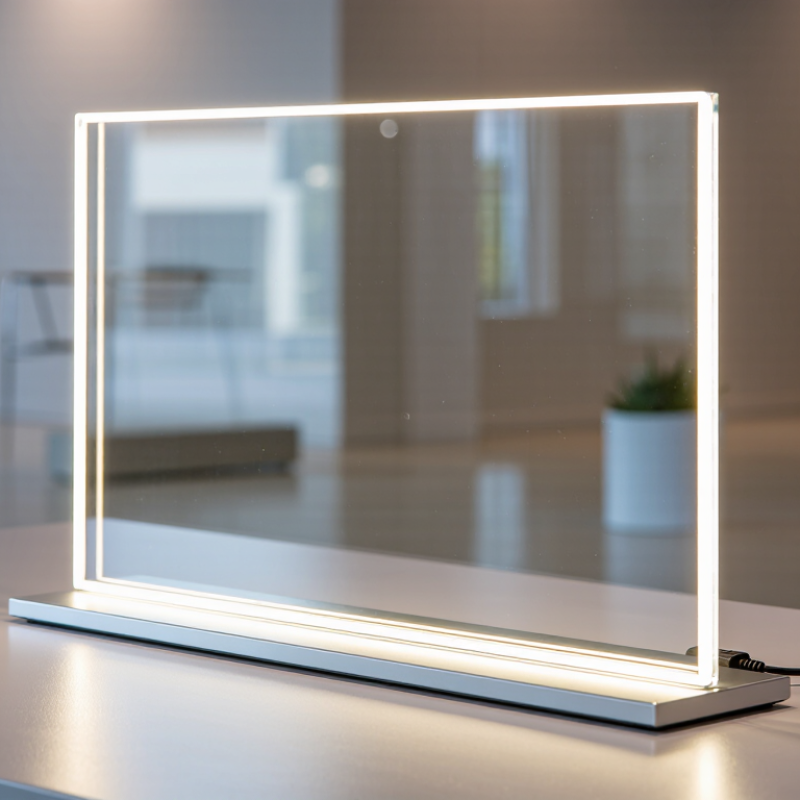
Acrylic LED Sign Boards: Definition, Structure, and Core Features
Acrylic LED sign boards combine transparent PMMA panels with light-emitting diodes, wiring, and a supporting frame. PMMA, commonly called acrylic, is lighter than glass and allows clean edge illumination. Many boards use laser-cut letters, an aluminum backplate, LED modules, and a concealed power supply. The panel may be clear, frosted, colored, or printed.
Digital signage demand provides useful market context. MarketsandMarkets’ 2024 Digital Signage Market report projects growth from approximately USD 27.8 billion in 2024 to USD 45.9 billion by 2029. Acrylic Led Boards serve a smaller visual-signage segment, but they benefit from the same demand for efficient, readable displays. Strong designs control glare, protect wiring, and distribute light evenly across narrow letters.
Brightness is not everything. An experienced fabricator checks LED spacing, color temperature, heat dissipation, and viewing distance. A poor layout creates bright spots behind the acrylic. That flaw is easy to miss indoors. UL Solutions and IEC-based safety practices also emphasize suitable enclosures, cable insulation, and power-supply protection. Weather-exposed boards need sealed edges and an appropriate IP rating, although “weatherproof” is often used too casually. Grand View Research reported that the global LED lighting market reached about USD 78.5 billion in 2023, reinforcing the importance of LED efficiency and long service life. Yet acrylic can scratch, yellow, or distort when specifications and maintenance are neglected.
2026 Best Acrylic LED Sign Board Suppliers Worldwide - Acrylic LED Sign Boards: Definition, Structure, and Core Features
Technical reference and supplier evaluation matrix for illuminated acrylic sign board sourcing
| Evaluation Dimension | Industry-Verified Specification or Standard | Recommended Requirement for Commercial Projects | Why It Matters When Selecting a Supplier |
|---|---|---|---|
| Product Definition | An acrylic LED sign board is a lighted sign made with acrylic panels, an LED light source, an electrical system, and a supporting enclosure or frame. | Confirm whether the quotation covers the acrylic face, LED modules or strips, power supply, wiring, frame, mounting hardware, and installation accessories. | Clear scope prevents missing components, unexpected costs, and incompatibility between the sign face and lighting system. |
| Acrylic Face Material | Cast and extruded acrylic are common sign-making materials. Acrylic is lightweight, weather-resistant, and available in clear, translucent, opal, and colored grades. | Use outdoor-grade acrylic with documented thickness and color stability. Select translucent or opal material when uniform light diffusion is required. | Material type affects machining quality, light transmission, impact resistance, color appearance, and service life. |
| Typical Acrylic Thickness | Common commercial sign faces typically use approximately 3–10 mm acrylic, depending on sign size, mounting method, and wind exposure. | Use thicker material or a reinforced frame for large panels, projecting signs, freestanding structures, or locations exposed to strong wind. | Insufficient thickness can cause bending, vibration, cracking around fasteners, or visible surface distortion. |
| Sign Structure | A typical assembly consists of an acrylic face, aluminum or galvanized-steel frame, LED light source, internal reflector or diffuser, rear cover, and mounting system. | Request an exploded drawing or sectional drawing showing the face, frame, LED layout, cable route, ventilation, drainage, and access points. | A documented structure makes fabrication, installation, maintenance, and replacement of components easier. |
| Lighting Technology | LED modules, LED strips, and edge-lighting systems are commonly used. Backlighting and face-lighting arrangements provide different brightness and halo effects. | Select LED modules with consistent color temperature, suitable optical lenses, and a layout designed for the sign depth and acrylic diffusion characteristics. | Correct LED placement reduces hotspots, dark areas, shadows, and uneven illumination. |
| Typical Color Temperature | Commercial white LED systems commonly use approximately 3,000–6,500 K, ranging from warm white to cool daylight white. | Specify the target color temperature and allowable variation in the purchase order. Use neutral white when consistent brand-neutral readability is required. | Color temperature changes the visual appearance of acrylic, printed graphics, and illuminated lettering. |
| Brightness Control | Brightness may be controlled by a constant-voltage driver, dimmer, timer, photocell, or digital controller, depending on the system design. | For outdoor installations, require adjustable output or automatic day/night control where local regulations or neighboring properties may be affected. | Adjustability supports energy savings, nighttime visibility, and compliance with site-specific lighting restrictions. |
| Power Supply | LED sign systems commonly use low-voltage DC power supplies, while the input side is connected to the local AC electrical network. | Verify input voltage, output voltage, rated capacity, efficiency, overload protection, short-circuit protection, and access for replacement. | A correctly sized and protected power supply improves reliability and reduces overheating or premature LED failure. |
| Electrical Safety | Outdoor signs require appropriate grounding, insulated connections, cable protection, weather-resistant junctions, and proper separation of mains and low-voltage wiring. | Ask for wiring diagrams, grounding details, component datasheets, and conformity documentation applicable to the installation market. | Electrical documentation supports safe installation, inspection, troubleshooting, and regulatory approval. |
| Ingress Protection | IP ratings classify protection against solids and water. The required rating depends on whether components are indoors, sheltered outdoors, or fully exposed. | For exposed outdoor components, request a suitable enclosure and sealed cable-entry solution, with the exact IP rating stated on the technical documentation. | Water ingress is a major cause of corrosion, short circuits, flickering, and LED module failure. |
| Frame and Housing | Aluminum is widely used because it is lightweight and corrosion-resistant. Galvanized or powder-coated steel may be selected for heavier structural requirements. | Specify alloy or steel grade, surface treatment, wall thickness, weld quality, fastener material, and corrosion-protection method. | The frame carries wind and handling loads and protects the acrylic and electrical components from environmental damage. |
| Surface Finish | Common finishes include polished, matte, frosted, painted, printed, and vinyl-applied surfaces. | Approve a physical color sample or digitally controlled color reference before mass production, especially for translucent or illuminated colors. | Lighting can change perceived color, contrast, and transparency compared with an unlit sample. |
| Outdoor Durability | Durability depends on UV exposure, temperature variation, moisture, wind load, fastener quality, sealant selection, and drainage design. | Require UV-resistant materials, corrosion-resistant hardware, drainage paths, replaceable components, and environmental testing appropriate to the location. | Outdoor durability is determined by the complete assembly rather than the acrylic face alone. |
| Thermal Management | LED efficiency does not eliminate heat generation. Heat can accumulate inside sealed sign cabinets and shorten component life. | Review ventilation, heat-dissipating surfaces, internal spacing, driver placement, and maximum operating temperature. | Effective thermal design supports stable brightness and reduces accelerated aging of LEDs, drivers, and wiring. |
| Light Uniformity | Uniformity is influenced by LED pitch, lens angle, installation depth, acrylic diffusion, reflective surfaces, and graphic opacity. | Request an illuminated prototype or sample section for large, shallow-depth, dark-colored, or complex-shaped signs. | Prototype validation is the most reliable way to identify hotspots and dark zones before production. |
| Fabrication Capability | Common processes include CNC routing, laser cutting, bending, polishing, printing, vinyl application, bonding, and metal fabrication. | Evaluate whether the supplier can manage acrylic fabrication, electrical assembly, structural fabrication, finishing, and final testing under one quality system. | Integrated production can reduce dimensional errors and coordination problems between separate subcontractors. |
| Quality Control | Important checks include dimensions, acrylic color, edge finish, LED placement, brightness, wiring polarity, insulation, grounding, and final appearance. | Request a written inspection plan with incoming-material checks, in-process checks, electrical tests, illumination tests, and final acceptance criteria. | Objective inspection criteria make supplier performance measurable and reduce disputes over defects. |
| Testing Documentation | Depending on the destination market, relevant documentation may include electrical test records, material data, photometric information, and conformity declarations. | Request documents that match the actual model, voltage, components, and destination-market requirements rather than generic certificates. | Product-specific documentation is more useful for compliance review, project approval, and after-sales support. |
| Packaging and Shipping | Acrylic is vulnerable to scratching, edge damage, impact, and deformation during transportation. | Require protective film, corner protection, shock-resistant internal packing, moisture control where needed, and clear package labeling. | Proper packaging protects finished surfaces and reduces damage claims during international transport. |
| Installation Support | Installation may require wall anchors, suspended hardware, brackets, structural supports, cable routing, and local electrical work. | Obtain mounting drawings, load information, anchor recommendations, wiring instructions, and a list of site-preparation requirements. | Accurate installation information reduces delays and helps local contractors install the sign safely. |
| Maintenance Design | Serviceable signs allow access to LED modules, drivers, wiring, and mounting points without destroying the acrylic face or enclosure. | Prefer replaceable LED modules and drivers, accessible inspection panels, labeled wiring, and readily available spare parts. | Maintenance-friendly construction lowers downtime and the total cost of ownership. |
| Supplier Selection Criteria | Key criteria include technical competence, production capacity, quality controls, documentation, communication, lead time, packaging, and service capability. | Compare suppliers using the same specification, approved sample, inspection plan, warranty terms, and delivery conditions. | A standardized comparison prevents decisions based solely on initial price and highlights long-term project risk. |
| Best-Fit Supplier Profile | The best-fit supplier is one that can demonstrate repeatable fabrication quality, transparent specifications, tested electrical components, and reliable project coordination. | Prioritize verified capability and documentation over broad product claims. Request references for projects with similar size, environment, and complexity. | Similar-project evidence provides a more relevant indication of performance than general catalog coverage. |
Note: Final material selection, electrical design, structural anchoring, ingress protection, and regulatory compliance should be confirmed for the specific sign size, installation environment, and destination market.