
How to Choose Aluminum French Doors in 2026?
Choosing French Doors Aluminum in 2026 requires more than admiring slim frames and bright glass. The right system should match your climate, wall structure, security needs, and daily habits. A French door facing a rainy garden needs stronger drainage than one opening onto a covered balcony. That detail matters.
Fenestration consultant Martin Holladay offers a useful principle: “A window or door must perform as part of the building envelope, not as a decoration.” His point applies directly to modern French Doors Aluminum. Look for thermally broken frames, low-emissivity double or triple glazing, multipoint locks, and tested weather seals. Ask for documented U-values, air-leakage ratings, water resistance, and hardware cycle testing. Do not rely on attractive showroom samples alone.
Measure the opening carefully. Check the sill height, floor level, swing clearance, and nearby furniture. A beautiful pair of doors can become frustrating when a rug blocks the threshold. Coastal homes may need enhanced corrosion protection. Cold regions need better thermal performance. Urban properties may benefit from laminated acoustic glass.
Budget honestly.
The cheapest quote may exclude installation, flashing, handles, or interior finishing. That omission can become expensive later. I would also question oversized panels without structural calculations. They look impressive, but weight affects hinges, alignment, and long-term operation. Product claims deserve evidence. Certified test reports are more dependable than vague promises. This guide explains how to compare materials, configurations, performance data, and installers before selecting French Doors Aluminum for a durable 2026 renovation.
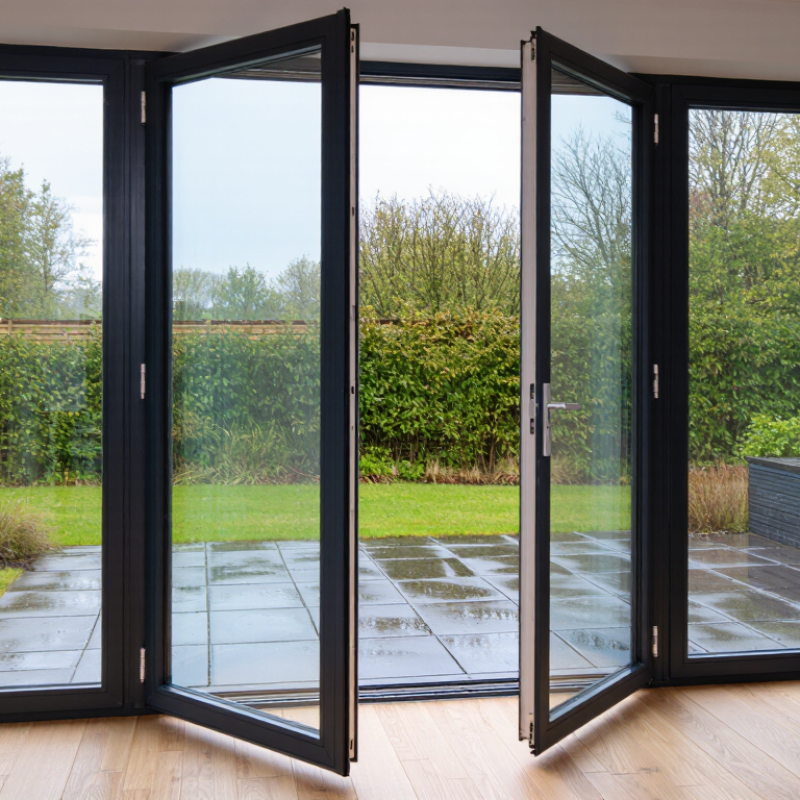
Define Your Needs for Aluminum French Doors
Defining your needs should come before choosing an aluminum French door. Measure the rough opening, wall thickness, swing direction, and daily traffic. A busy patio needs a wider clearance and stronger hardware. A quiet study may need laminated glass and tighter seals. Write these details down.
Climate matters more than appearance. The U.S. Department of Energy reports that windows cause roughly 25–30% of residential heating and cooling energy use. Aluminum transfers heat quickly, so choose thermally broken frames for exposed rooms. Check the NFRC label for U-factor and solar heat gain coefficient. Lower U-factor usually means better insulation, while SHGC should match your climate and sunlight. South- and west-facing glass can make an attractive room uncomfortably hot.
Think about maintenance, security, and long-term use. Ask for tested air, water, structural, and operating ratings under recognized fenestration standards. Select multi-point locks if the door is a main entrance, but confirm that every household member can operate them easily. Low-maintenance finishes help in coastal or humid areas, though no finish is maintenance-free. Not every large glass panel improves a home. Sometimes, I would choose less glass and better shading. Review your budget again after adding glazing, screens, drainage, installation, and future adjustment costs. A beautiful door can still be the wrong door.
How to Choose Aluminum French Doors in 2026? - Define Your Needs for Aluminum French Doors
| Selection Dimension | Common Data or Range | Recommended Choice | Why It Matters |
|---|---|---|---|
| Door Configuration | Single door, French pair, or French pair with fixed sidelights | Choose a pair for wider access; add sidelights when more daylight and a wider visual opening are needed. | The configuration affects wall opening size, structural requirements, ventilation, and installation cost. |
| Clear Opening | Common French-door leaf widths: approximately 610–915 mm (24–36 in) each | Select the largest practical opening that suits furniture movement, accessibility, and available wall space. | The nominal door size is not the same as the final clear passage; account for frames, hinges, and the active leaf. |
| Door Height | Common residential heights: approximately 2,030–2,440 mm (80–96 in) | Match the existing structural opening or select a taller system only after confirming lintel and headroom requirements. | Larger doors increase glass area, weight, wind load, and installation demands. |
| Thermal Performance | High-performance aluminum doors may achieve U-factors around 0.20–0.40 Btu/h·ft²·°F, depending on the complete tested assembly. | Use thermally broken aluminum frames and compare whole-door U-factor values. | Lower U-factor means better resistance to heat transfer. Frame, glass, spacer, and edge conditions all affect performance. |
| Glazing Type | Double glazing is common; triple glazing provides additional insulation where climate and frame capacity justify it. | Choose low-emissivity coated insulating glass with an appropriate gas fill and warm-edge spacer when energy efficiency is important. | Glass often represents most of the door area, so its solar and thermal properties strongly influence comfort. |
| Solar Control | Solar Heat Gain Coefficient (SHGC) commonly ranges from about 0.25 to 0.60 for low-emissivity residential glazing. | Use lower SHGC for strong sun and hot climates; use a moderate or higher SHGC where passive winter heat is beneficial. | Lower SHGC reduces unwanted solar heat gain but may also reduce useful winter sunlight. |
| Weather Resistance | Look for independently tested air, water, and structural performance; air leakage targets of 0.3 cfm/ft² or lower are commonly used for efficient fenestration. | Select a system tested for the project’s wind exposure and rainfall conditions, with continuous perimeter seals and a drained sill. | A durable frame cannot compensate for poor sill drainage, incorrect flashing, or inadequate installation. |
| Threshold Design | Standard thresholds provide stronger weather protection; low or flush thresholds improve accessibility but require careful drainage design. | Choose a low threshold only when it meets local water-management and accessibility requirements. | Threshold height affects wheelchair access, trip safety, water resistance, and compatibility with finished flooring. |
| Security Hardware | Multi-point locks, adjustable hinges, laminated glass, and reinforced keep areas are available on many systems. | Prioritize a multi-point locking system, secure cylinders, robust hinges, and safety-rated glass where appropriate. | Security depends on the complete door assembly, including glass, hardware, frame anchoring, and installation. |
| Acoustic Performance | Typical residential insulated glazing may provide approximately 28–35 dB sound reduction; laminated or specialized glazing can improve this. | Use laminated acoustic glass and well-sealed frames near roads, airports, or dense urban areas. | Sound performance is affected by glass thickness, air gaps, seals, frame joints, and installation quality. |
| Finish and Color | Powder coating and anodizing are common aluminum finishes; darker colors generally absorb more solar heat. | Choose a tested exterior-grade finish with documented color retention and corrosion resistance. | Finish quality influences appearance, maintenance frequency, and long-term resistance to weather exposure. |
| Maintenance Requirements | Clean frames and tracks with mild detergent and water; keep drainage paths clear and lubricate hardware according to instructions. | Choose accessible tracks, replaceable weather seals, and serviceable hardware. | Routine cleaning helps prevent blocked drainage, stiff operation, seal damage, and premature corrosion. |
| Installation and Warranty | Performance depends on accurate measurement, adequate structural support, flashing, shimming, sealing, and adjustment. | Confirm measured opening tolerances, installation responsibilities, glass coverage, finish coverage, and hardware coverage before ordering. | A well-designed door can underperform if the opening is out of square or the installation does not control water and air leakage. |