
Contract Manufacturing for Injection Molded Plastic Products in North America
(800) 824.0607

RFQ / CONTACT
Contract Manufacturing for Injection Molded Plastic Products in North America | (800) 824.0607

Top 10 Types of Mechanical Parts for Global Buyers

Buying Mechanical Parts across borders requires more than comparing prices. A bearing, gear, shaft, or fastener may look simple, yet its material grade, tolerance, coating, and operating environment can determine equipment performance. A part that fits on paper may fail under heat, vibration, dust, or repeated loads. Small differences matter.

“The best way to learn about anything is to take it apart,” wrote engineering historian Henry Petroski. His observation reflects a practical truth for global buyers: specifications become meaningful when connected to real use. This guide examines the Top 10 Types of Mechanical Parts for Global Buyers, from power-transmission components to motion-control and fastening solutions. Each category deserves attention to dimensions, load ratings, inspection records, packaging, and supplier consistency. Ask difficult questions.

Experienced procurement teams often request drawings, material certificates, sample approvals, and traceable quality data before placing large orders. They also check whether a supplier can maintain tolerances across repeated production batches. However, no checklist removes every risk. Measurements may vary slightly, and field conditions can expose weaknesses that laboratory tests miss. That limitation deserves honest consideration.

The goal is not to identify one universally superior part. It is to match the right Mechanical Parts with the machine, duty cycle, maintenance plan, and purchasing requirements. Clear communication remains essential, especially when technical terms cross languages and manufacturing cultures. Reliable decisions begin with evidence, but they improve through careful testing and reflection.
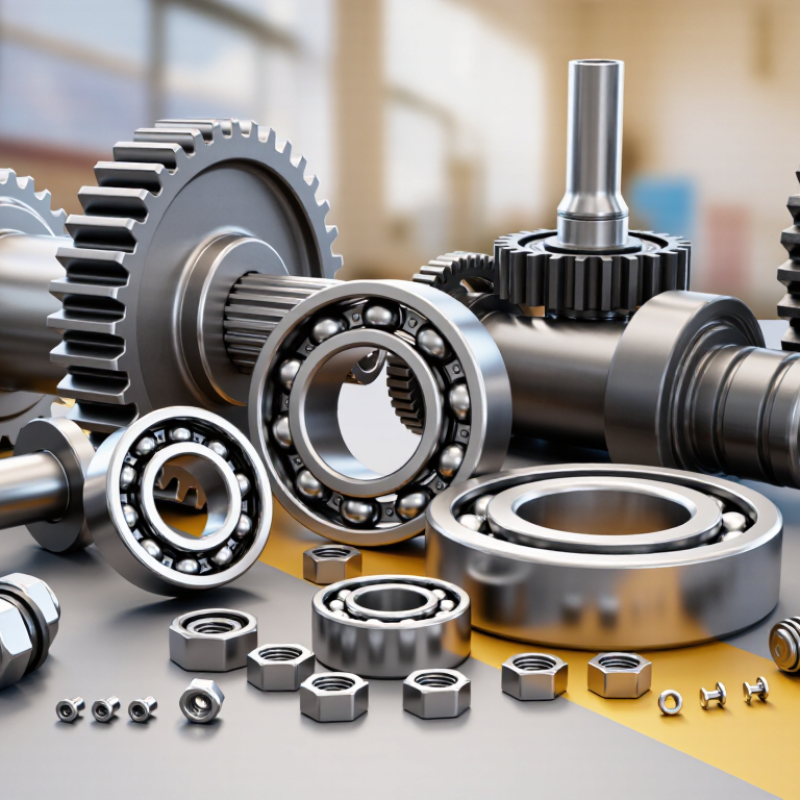
Top 10 Types of Mechanical Parts for Global Buyers

Mechanical Parts: Definition, Scope, and Role in Global Manufacturing

Mechanical parts are engineered components that transmit motion, support loads, control alignment, or protect moving systems. Their scope includes fasteners, shafts, gears, bearings, springs, seals, couplings, bushings, brackets, and precision castings. Together, these ten types form the working structure of pumps, conveyors, vehicles, production lines, and industrial equipment. A small bearing can affect an entire assembly. A poorly matched seal may cause early leakage.

For global buyers, mechanical parts are more than catalog items. Their role depends on material grade, dimensional tolerance, surface treatment, load capacity, operating temperature, and service environment. Practical purchasing experience shows that a clear technical drawing prevents costly misunderstandings. Buyers should also request inspection records, sampling details, packaging requirements, and traceability information. Yet a specification can still be incomplete. Real conditions often reveal vibration, dust, heat, or installation problems that drawings fail to show. Careful supplier communication matters.

Tips: Compare samples against approved drawings. Check critical dimensions with calibrated tools. Ask how parts perform under repeated loads, not only static tests. Allow time for design review. Small details matter. A rushed decision may fit today but fail during continuous production.

Top 10 Types of Mechanical Parts for Global Buyers

Mechanical Parts: Definition, Scope, and Role in Global Manufacturing

Mechanical parts are manufactured components used to transmit motion, support loads, control movement, seal systems, or connect assemblies. The chart compares representative material densities commonly associated with ten widely sourced mechanical-part categories. Density is shown in grams per cubic centimeter (g/cm³); actual values vary by grade, treatment, and product specification.

Ten Core Mechanical Part Types and Their Common Industrial Uses

Top 10 Types of Mechanical Parts for Global Buyers

Ten Core Mechanical Part Types and Their Common Industrial Uses

Mechanical parts rarely work alone. Bolts and nuts secure machine frames, while screws fasten panels, covers, and smaller assemblies. Washers spread clamping pressure and help protect painted or softer surfaces. Gears transfer rotary motion between shafts, with tooth size and alignment affecting noise, speed, and service life. Shafts carry torque in motors, pumps, conveyors, and gearboxes. Small errors matter.

Bearings support rotating shafts and reduce friction in fans, production lines, and material-handling equipment. Couplings connect shafts while allowing limited misalignment, although their real performance depends on installation accuracy. Springs store and release energy in valves, switches, suspension systems, and automated tooling. Seals prevent oil, dust, water, or process fluids from entering moving assemblies. Their material must match temperature, pressure, and chemical exposure.

Specifications should include dimensions, load requirements, surface treatment, material grade, and inspection methods. Experienced buyers also check thread fit, hardness, runout, and packaging protection before shipment. A part may look correct but fail after repeated vibration. That is an easy mistake to underestimate. Tolerances can increase cost, yet loose tolerances may create maintenance problems. Supplier drawings, sample testing, and traceable inspection records make purchasing decisions more dependable across different production environments.

Key Materials, Designs, and Performance Features to Compare

Top 10 Types of Mechanical Parts for Global Buyers

Key Materials, Designs, and Performance Features to Compare

Global buyers should compare bearings, gears, shafts, fasteners, seals, springs, couplings, bushings, pulleys, and linear guides by working conditions. Material choice sets the baseline. Carbon steel offers strength and affordability, while stainless steel improves corrosion resistance. Engineering plastics reduce weight and noise. World Steel Association data shows global crude steel production reached about 1.89 billion tonnes in 2023, confirming steel’s continuing industrial importance.

Design details often decide service life. A bearing needs correct clearance, hardness, lubrication, and load capacity. ISO 281 uses basic rating life to compare rolling bearings under defined loads. It does not predict every field failure. Contamination, misalignment, and poor installation still matter. Fit matters. Do not guess.

Performance data should match the application, not just the catalogue. Compare tensile strength, fatigue resistance, temperature range, surface finish, and dimensional tolerance. The U.S. Department of Energy reports that motor-driven systems consume roughly 70% of industrial electricity in the United States. Efficient gears, couplings, and shafts can therefore reduce energy losses, especially during continuous operation. A shiny coating may hide weak geometry. Buyers should request test results, traceable material certificates, and tolerance records. Cost remains important, but the cheapest part can become expensive after premature replacement.

Global Standards, Tolerances, and Compatibility Requirements

Top 10 Types of Mechanical Parts for Global Buyers

Global Standards, Tolerances, and Compatibility Requirements

Shafts, gears, bearings, fasteners, springs, seals, couplings, brackets, pins, and housings need more than dimensional accuracy. Buyers must define the governing standard, material grade, surface finish, and inspection method. ISO 286 establishes tolerance classes for holes and shafts, such as H7 and g6. These codes help suppliers produce compatible fits across different countries. However, tolerance alone does not guarantee performance. A shaft may meet its diameter requirement but still fail because of poor roundness or excessive surface roughness.

Thread compatibility creates another frequent risk. Metric threads and inch-based threads can appear similar, yet they are not interchangeable. A 10 mm bolt cannot replace a 3/8-inch bolt safely. Specify pitch, thread class, flank angle, and gauge requirements. For drawings, ASME Y14.5 supports clear geometric tolerancing, while ISO 2768 can simplify general tolerances for non-critical features. Keep critical dimensions separately controlled.

Quality systems also influence buyer confidence. The 2023 ISO Survey recorded 1,265,216 ISO 9001 certificates across 189 countries and economies. This figure shows the scale of global quality management, not automatic part quality. Request inspection records, material certificates, calibration dates, and sample measurements. A useful check is a 20°C measurement room. Still, this is often overlooked. One practical weakness remains: buyers sometimes copy tolerances from old drawings without reviewing real operating loads, assembly tools, or thermal expansion. That habit deserves reconsideration.

How Buyers Evaluate Suppliers, Quality, Costs, and Delivery Risks

Top 10 Types of Mechanical Parts for Global Buyers

Global buyers often source bearings, gears, shafts, fasteners, springs, seals, couplings, brackets, bushings, and housings. Each part creates different supplier risks. A bearing may need precise hardness control, while a bracket may depend more on clean welding and stable dimensions. Buyers should review drawings, material certificates, inspection records, and production capacity before discussing price. A low quotation can hide tooling fees, weaker materials, or unclear packaging standards.

Quality must be measurable. Ask for tolerance reports, surface-finish readings, and sample approval records. Check whether the supplier uses calibrated equipment. Request photos of production stages, not only finished parts. Delivery risk deserves equal attention. Confirm raw-material availability, processing time, inspection time, and shipping plans in writing. One missed batch can stop an entire assembly line. Yet planning is rarely perfect. Port delays, rejected samples, or sudden material shortages still happen. Buyers should leave realistic schedule space.

Tips: Compare at least three suppliers using the same drawing and quality standard. Ask for a pre-production sample. Review hidden costs, including molds, testing, packing, and replacement parts. A video audit can reveal crowded work areas or manual processes, but it cannot replace an on-site inspection. Keep approval records organized. Small details matter.

Top 10 Types of Mechanical Parts for Global Buyers - How Buyers Evaluate Suppliers, Quality, Costs, and Delivery Risks

No. Mechanical Part Type Typical Applications Common Materials Typical Dimensional Tolerance Common Manufacturing Process Indicative Unit Cost at 1,000 Pieces Typical Production Lead Time Quality Checks Buyers Commonly Require Delivery Risk What Buyers Usually Prioritize
1 CNC Machined Shafts Power transmission, pumps, motors, automation equipment Carbon steel, stainless steel, alloy steel, aluminum Generally ±0.02–0.05 mm; tighter areas may require ±0.01 mm CNC turning, milling, grinding, heat treatment US$2–18, depending on diameter, material, and finishing 3–6 weeks after drawing approval Dimensional inspection, concentricity, runout, surface roughness, material certification, hardness Medium Runout control, material traceability, repeatability, and corrosion protection
2 Gears and Sprockets Gearboxes, conveyors, agricultural machinery, industrial drives Alloy steel, carbon steel, stainless steel, engineering plastics Typically ISO grade-dependent; tooth profile and pitch accuracy are critical Hobbing, shaping, broaching, CNC machining, heat treatment US$4–45, depending on module, size, tooth count, and heat treatment 4–8 weeks after technical confirmation Tooth profile, pitch error, backlash, hardness, case depth, runout, visual inspection High Tooth accuracy, wear resistance, noise performance, and stable heat treatment
3 Bearings and Bushings Rotating equipment, electric motors, pumps, linear motion systems Bearing steel, bronze, brass, PTFE composites, sintered metals Usually controlled in microns for bore, outside diameter, and clearance Precision turning, grinding, honing, sintering, surface treatment US$0.80–20, depending on size, precision, and construction 2–6 weeks for standard designs; longer for custom parts Bore and outside diameter, radial clearance, roundness, surface finish, noise, lubrication compatibility Medium Dimensional stability, service life, low friction, cleanliness, and reliable packaging
4 Fasteners Construction equipment, automotive assemblies, machinery frames, maintenance parts Carbon steel, stainless steel, alloy steel, brass Standard-based tolerance; thread class and length accuracy are key Cold heading, thread rolling, machining, heat treatment, plating US$0.03–2.50, depending on size, grade, finish, and quantity 2–5 weeks for standard products; 5–8 weeks for special designs Thread gauge inspection, tensile strength, proof load, hardness, coating thickness, salt spray testing Low Correct grade, thread compatibility, coating durability, packaging, and lot consistency
5 Metal Brackets and Mounting Plates Electrical cabinets, HVAC equipment, automation systems, machine frames Carbon steel, stainless steel, aluminum Typically ±0.10–0.30 mm for formed features; tighter holes may require more control Laser cutting, punching, bending, welding, powder coating US$1–12, depending on thickness, geometry, and finishing 2–5 weeks after drawing approval Hole position, bend angle, flatness, weld quality, coating thickness, appearance Low Fit-up accuracy, surface protection, packaging against deformation, and low tooling cost
6 Cast Housings Gearboxes, pumps, valves, motors, industrial control equipment Cast iron, ductile iron, aluminum alloy, steel casting As-cast tolerance is broader; machined interfaces commonly require ±0.05–0.20 mm Sand casting, investment casting, die casting, CNC machining US$8–120, excluding or including tooling depending on quotation structure 6–12 weeks, including tooling and first-article approval Porosity, wall thickness, hardness, pressure leakage, machining allowance, dimensional inspection High Defect prevention, tooling control, pressure integrity, machining consistency, and schedule management
7 Precision Pins and Rollers Linkages, hinges, chain systems, indexing mechanisms, linear guides Hardened steel, stainless steel, tool steel, bearing steel Commonly ±0.005–0.03 mm for diameter and controlled roundness CNC turning, centerless grinding, heat treatment, polishing US$0.20–8, depending on diameter, length, hardness, and finish 3–6 weeks after specification approval Diameter, roundness, straightness, hardness, surface roughness, magnetic particle testing where applicable Medium Wear resistance, smooth movement, surface finish, and consistent batch dimensions
8 Springs Valves, actuators, suspension systems, latches, industrial controls Spring steel, stainless steel, music wire, nickel alloys Free length and force tolerance depend on design; force accuracy is often more important than size Wire forming, coiling, heat setting, shot peening, surface coating US$0.10–6, depending on wire diameter, shape, and performance requirements 3–6 weeks after sample approval Load-deflection test, free length, coil diameter, cycle life, surface defects, material composition Medium Consistent force, fatigue life, correct material, corrosion resistance, and sample validation
9 Seals and O-Rings Hydraulic systems, pneumatic equipment, pumps, engines, fluid-control assemblies NBR, EPDM, FKM, silicone, polyurethane, PTFE Standard groove and seal dimensions; compression and flash limits are critical Compression molding, injection molding, extrusion, die cutting US$0.05–5, depending on compound, size, profile, and tooling 3–8 weeks for custom profiles; standard sizes may be faster Material compound, hardness, compression set, leakage, dimensional inspection, temperature and chemical compatibility Medium Correct compound, sealing performance, shelf life, traceability, and contamination control
10 Welded Frames and Fabricated Assemblies Machine bases, material-handling systems, safety guards, industrial platforms Carbon steel, stainless steel, aluminum Overall assembly tolerance commonly ±1–3 mm; machined interfaces require tighter control Laser cutting, bending, welding, stress relieving, machining, painting US$25–600, depending on size, weight, weld length, and finishing 4–10 weeks after drawing and welding procedure approval Weld visual inspection, dimensional alignment, weld penetration, flatness, load testing, coating inspection High Structural integrity, distortion control, lifting and packing plans, inspection documentation, and on-time capacity
Cost ranges are indicative reference estimates in US dollars for repeat production at approximately 1,000 pieces. Actual pricing varies with material grade, geometry, tolerances, tooling, surface treatment, inspection requirements, order quantity, packaging, and shipping terms. Lead times refer to production after drawing approval and do not include international transportation or customs clearance.